Loop Walk or Out-and-Back: Choosing a City Route
Choose a loop walk or an out-and-back city route by matching your starting point, energy, and appetite for variety to a walk that feels right.
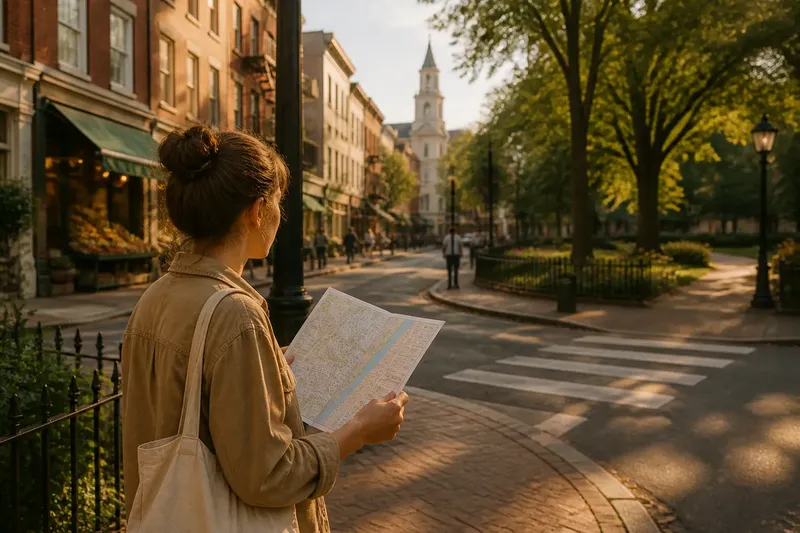
The common mistake with a loop walk or an out-and-back city route is choosing by map shape alone. A route that looks tidy can leave you trudging past the same blank frontage, while a return walk can turn into a pleasant second look at a street you barely noticed on the way out. Start with your actual departure point and the kind of outing you want; the route shape should serve those choices.
Choose a loop when variety matters more than a familiar finish
A loop leaves and returns to roughly the same place by different streets. It suits a walk that is meant to feel like a small tour: perhaps you want to pass through a residential block, cross a commercial strip, and come back beside a park. Each leg brings a different view, and you do not need to decide where to catch transit at the end.
Loops work especially well when your starting point is fixed. If you have parked near a museum, are meeting someone at a café, or need to return to a hotel lobby, you can build the walk around that anchor. The practical payoff is simple: you end where you began, with a route that can show several sides of the neighborhood.
Variety does come with a tradeoff. The return leg may feel less direct, and a loop can send you along streets chosen mainly to close the circuit. Check the whole line, not just the interesting destination. Look for a comfortable way back using pedestrian-friendly blocks, public paths, and crossings that make sense on foot.
Choose an out-and-back when the destination earns a second look
An out-and-back uses the same general corridor in both directions. It is a strong fit when one destination is the point of the outing: a waterfront path, a market street, a row of historic storefronts, or a public garden reached from a convenient station. You can walk toward it at an easy pace, spend time there, then return without having to invent a new route.
The repeated streets are not necessarily a drawback. Facing the opposite direction changes what stands out: a painted sign, a church tower, or the way a shopfront sits against the next block. That makes a return route appealing when you want a steady, low-decision walk rather than a succession of unfamiliar turns.
It can be less satisfying if the outward stretch is noisy, monotonous, or crowded. Consider whether you would welcome seeing it twice. If not, a parallel street may offer a better return, turning the outing into a loose loop without adding a complicated navigation plan.
Match the route to your starting point and energy
Your start determines what counts as convenient. From a transit station, an out-and-back can follow a clear pedestrian corridor and bring you back to the same entrance. From a neighborhood café, a loop may make better use of the nearby blocks. If you are walking between two appointments, neither shape may be ideal: a one-way route can finish near your next stop, as long as you know how you will continue afterward.
Energy matters, too. A loop may feel lively early on but frustrating if its final leg is long and unfamiliar. An out-and-back lets you turn around when you have had enough, though you still need to retrace your steps. Choose a destination or turnaround point that can be shortened without leaving you stranded far from transit or a comfortable place to pause.
Say you are starting at a library and have time to stroll through a nearby market district. If the market is the main attraction and its streets are pleasant, an out-and-back keeps the walk simple and lets you linger before returning. If you also want to see a quiet park and a different shopping street, a loop can connect them and bring you back to the library. The route changes because the outing’s purpose changes, not because one shape is universally better.
Read the map for walkability, not just distance
A map can make a route look easy while hiding awkward pedestrian details. Before setting out, check whether the streets have sidewalks, whether a park path has an open entrance where you need it, and whether a large road forces a detour. A loop’s neat geometry is no help if its closing stretch depends on an unpleasant crossing.
Use a map app to trace the actual walking route, then scan the street view or map labels where the line makes a sharp turn. Look for pedestrian lanes, public stairways, bridges, and entrances rather than assuming a short line is a usable path. In a dense neighborhood, a block or two of extra walking can lead to a much more comfortable connection.
Keep one simple backup in mind. For a loop, note a nearby transit stop or a direct street back to your start. For an out-and-back, identify a reasonable point to turn around. These small decisions make it easier to adapt if the street feels busier or less inviting than the map suggested.
Which city route fits the outing?
Is a loop walk better for seeing more of a neighborhood?
Often, yes, if you want to combine different blocks and return to one fixed starting place. It is less appealing when the route’s final stretch is awkward or the extra streets do not add anything you care about.
Is an out-and-back route boring?
Not automatically. A destination with changing details, such as a market street or waterfront, can hold attention, and the opposite view on the return often reveals things you missed.
What if I want variety but need a simple route?
Try a short out-and-back with one parallel street on the return. You keep the destination and familiar direction of a return walk while changing enough of the route to make the way back feel fresh.
How should I choose when my walk has no fixed destination?
Pick the route shape that makes the start and finish easiest. A loop suits a walk that begins and ends at the same useful place; an out-and-back suits a corridor you are happy to revisit and lets you decide when to turn around.
Make the choice before you leave
Ask yourself three things: Where must I start or finish? Is there one destination I want to spend time at? Would I enjoy seeing the same street twice? If the starting point is fixed and variety is the goal, choose a loop. If one place or corridor is the attraction, choose an out-and-back. If you want both a clear destination and a little novelty, return by a nearby parallel street.
For a city route, the best shape is the one that supports the outing you actually have time and energy for. A quick look at crossings, entrances, and transit options can help you choose a walk that feels natural once you are on the pavement. Keep the plan flexible: noticing a side street or deciding to linger is part of walking the city, not a failure to follow the map.